Is Dental Treatment Covered by Insurance USA

Is Dental Treatment Covered by Insurance USA policies often creates more questions than answers for patients seeking necessary care. The landscape of dental insurance is complex, with varying levels of coverage, different plan types, and specific limitations that can be confusing to navigate. Understanding the fundamentals of how these plans work is the first step toward maximizing your benefits and making informed decisions about your oral health, whether you’re considering treatment at home or abroad. The reality is that while some treatments are generously covered, many major procedures leave patients with significant out-of-pocket expenses, pushing them to explore more affordable, high-quality alternatives.
Understanding the Core Types of Dental Insurance
Before diving into what specific treatments are covered, it’s essential to understand the primary models of dental insurance available in the United States. The type of plan you have will be the single most significant factor in determining your network of dentists, your premium costs, and your out-of-pocket expenses for any given procedure. Most plans fall into one of a few main categories, each with distinct advantages and disadvantages.
Preferred Provider Organization (PPO)
PPO plans are among the most popular due to their flexibility. These plans have a network of “preferred” dentists and specialists who have agreed to provide services at a discounted rate. Patients are free to see dentists both inside and outside of this network. However, staying in-network results in lower co-payments and maximizes insurance benefits. Choosing an out-of-network provider means you will pay a higher portion of the bill, and the insurance company will cover less. PPOs typically have higher monthly premiums than other plan types but offer a wider choice of providers.
Dental Health Maintenance Organization (DHMO)
DHMO plans operate on a more restrictive model but often come with lower monthly premiums and no deductibles or annual maximums. With a DHMO, you must choose a primary care dentist from within the plan’s network. This dentist will manage all your dental care needs. If you require specialized treatment, your primary dentist must provide a referral to a specialist who is also within the DHMO network. There is typically no coverage for any services received from an out-of-network provider, except in very specific emergency situations.
Indemnity Plans (Fee-for-Service)
Also known as traditional insurance, indemnity plans offer the greatest freedom of choice. You can see any dentist you wish without needing a referral. The plan pays a percentage of the “usual, customary, and reasonable” (UCR) fee for a given service. For example, the plan might cover 80% of the cost of a filling. You would be responsible for the remaining 20%. These plans often have deductibles and an annual maximum. While they provide maximum flexibility, their premiums can be higher, and you may need to pay the dentist upfront and submit a claim to the insurance company for reimbursement.
| Feature | PPO Plan | DHMO Plan | Indemnity Plan |
|---|---|---|---|
| Dentist Choice | Flexible; can go in or out of network (costs vary) | Restricted; must use in-network dentists and get referrals | Unrestricted; can see any licensed dentist |
| Monthly Premium | Higher | Lower | Highest |
| Deductible | Yes, typically an annual deductible applies | No, typically no deductible | Yes, typically an annual deductible applies |
| Annual Maximum | Yes, there is a yearly limit on what the plan will pay | No, typically no annual maximum | Yes, there is a yearly limit on what the plan will pay |
| Claim Process | In-network dentist usually files claims; out-of-network may require you to file | No claim forms; care is managed by the primary dentist | Patient often pays upfront and files for reimbursement |
The “100-80-50” Rule: A Common Coverage Structure
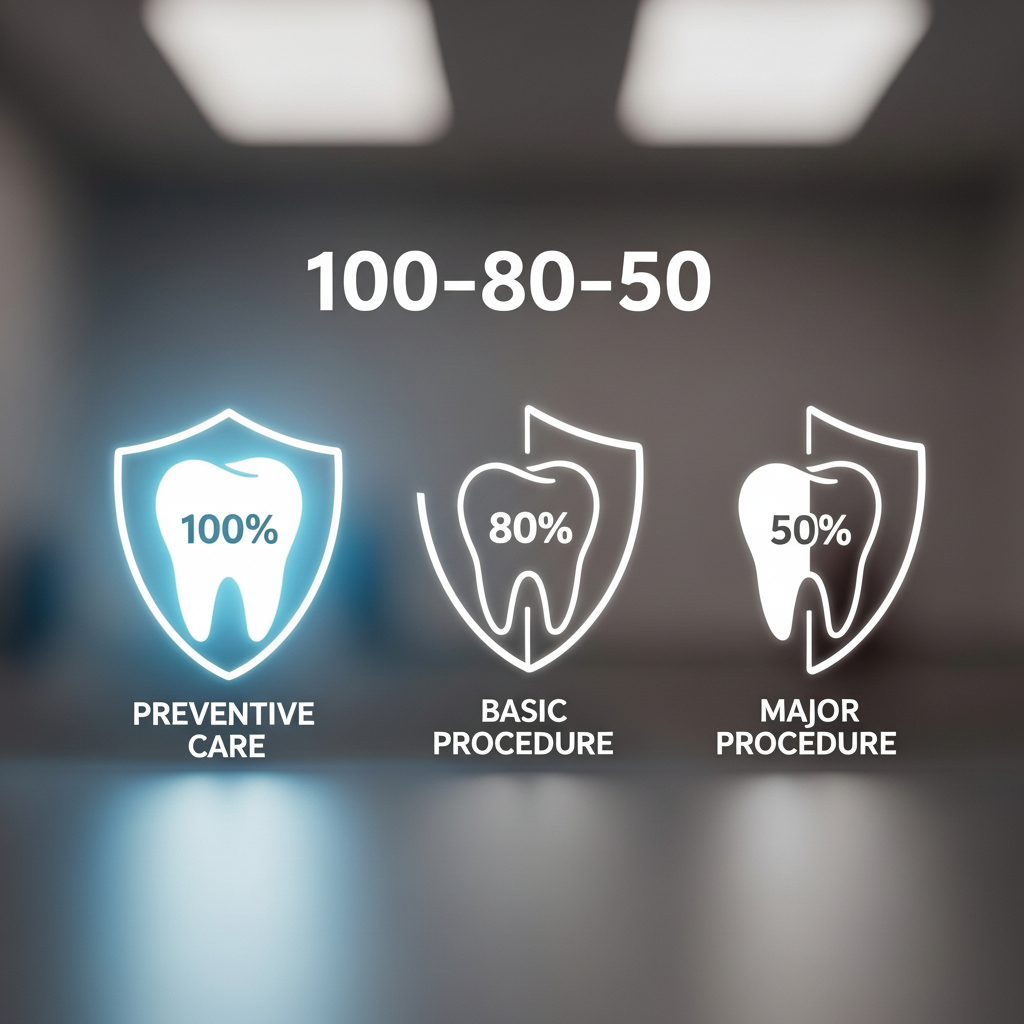
Many dental insurance plans, particularly PPOs, follow a tiered coverage structure often referred to as the “100-80-50” rule. This framework dictates the percentage of costs the insurance company will cover for different categories of dental services. While the exact percentages can vary by plan, this structure provides a general guideline for what to expect.
Preventive Care: Typically 100% Coverage
Insurance companies want to keep you healthy to avoid paying for more expensive procedures down the line. For this reason, preventive services are almost always covered at the highest level, often 100%, with no deductible applied. This category includes:
- Routine oral exams (usually twice per year)
- Teeth cleanings (prophylaxis)
- Standard X-rays (such as bitewings)
Basic Procedures: Typically 80% Coverage
This category covers common treatments needed to address decay or minor dental problems. After you meet your deductible, the insurance plan will typically cover around 80% of the cost. You are responsible for the remaining 20%. Basic procedures often include:
- Fillings for cavities
- Simple tooth extractions
- Root canal therapy
- Treatment for gum disease (periodontics)
Major Procedures: Typically 50% Coverage
Major procedures are the most complex and expensive treatments, and consequently, they receive the lowest level of coverage. Your plan will likely only cover about 50% of the cost for these services, and this is where the annual maximum limit becomes a significant factor. Major procedures usually encompass restorative work such as:
- Dental crowns (caps)
- Bridges
- Dentures
- Dental implants
Limitations: Annual Maximums, Waiting Periods, and Exclusions
Even with a good insurance plan, several factors can limit your actual benefits. The most significant is the annual maximum. This is the absolute most your insurance plan will pay for your dental care in a single plan year. In the USA, this amount is often quite low, typically ranging from $1,000 to $2,000. For a single major procedure like a dental implant or crown, this maximum can be exhausted very quickly, leaving you to pay the rest out of pocket. Furthermore, many plans impose waiting periods for major procedures. You might have to be enrolled in the plan for six to twelve months before you are eligible for coverage for a crown or bridge. Finally, certain treatments are almost always excluded. For a comprehensive overview of dental insurance plans, it is clear that cosmetic procedures like teeth whitening, veneers, and bonding are generally not covered as they are not considered medically necessary.
Is Dental Treatment Covered by Insurance for Implants?

This is one of the most common questions from patients needing to replace a missing tooth. The answer is complex. Historically, dental implants were often classified as a cosmetic procedure and excluded from coverage entirely. Today, more and more insurance plans are beginning to offer some level of coverage for implants, recognizing them as a durable and effective standard of care. However, they are almost always classified as a “major” procedure, meaning coverage is limited to around 50%, and that’s before factoring in the annual maximum. A single implant, abutment, and crown can cost thousands of dollars in the US, far exceeding the typical annual maximum. Therefore, even with insurance, a patient’s out-of-pocket cost for a dental implant can still be substantial.
Dental Tourism: A Solution for High Out-of-Pocket Costs
The significant gaps in US dental insurance—low annual maximums, high co-pays for major work, and complete exclusion of many procedures—have led many patients to seek high-quality, affordable care abroad. This practice, known as dental tourism, allows patients to receive world-class treatment for a fraction of the domestic cost. Countries like Turkey have become premier destinations for dental care, boasting state-of-the-art clinics, highly experienced dentists, and transparent pricing. Even after accounting for travel and accommodation, the total cost for major restorative work, such as a full set of dental implants or veneers, can be 50-70% less than in the United States. This enormous difference in the cost of dental implants in Turkey versus the USA makes comprehensive treatment accessible. For many Americans, it is more affordable to pay entirely out-of-pocket for superior care in Turkey than to use their insurance at home and still be left with a massive bill. Some PPO or indemnity plans may even reimburse for a portion of international care, but the primary benefit remains the dramatic upfront savings that bypass the limitations of domestic insurance altogether.